
Project Proposal
Student Name
Capella University
NURS-FPX9010
Professor Name
Submission Date
Outpatient infusion-related complications continue to be a problem with regard to patient safety. In the current project site, a privately owned outpatient wellness and infusion center, baseline data illustrate that as much as 14 percent of infusion encounters had complications with documentation (Clinical Director, personal communication, January 15, 2026). Victorious inconsistencies in measuring IV sites, differences in following aseptic techniques, and people not recording all procedures were all important factors (Nickel et al., 2024). Peripheral complications of IVs (e.g., phlebitis, infiltration, catheter occlusion) result in additional discomfort for a patient and are an interruption in continuity of care (Marsh et al., 2024). Standardization of evidence-based best practices of care will help close the patient safety and quality of care gaps.
How does Infusion Therapy Standard with structured IV site assessment and the use of aseptic technique training (I) for outpatient infusion therapy (P) compare to current practice (C) in adult patients with the incidence of infusion-related complications (O) over 8 weeks (T)? A body of published literature supported a structured, comprehensive infusion care protocol, which has been shown to reduce peripheral IV catheters and improve the accuracy of written documentation related to the care of the catheters (Demiroğlu & Tosun, 2025).
When competency-based training courses are used to provide evidence-based guidelines for assessing nursing practice with regard to the standardisation of assessment and infection prevention processes, adherence to the guidelines by nurses increased (Lewis et al., 2022). The use of evidence-based quality improvement (QI) models has consistently shown that there are quantifiable reductions in preventable adverse events in the ambulatory care setting related to infusion-related procedures.
Practice Problem
The Clinical Director provided a retrospective review of infusion records for eight weeks over the course of which 14% of infusion-related experiences had complications (Clinical Director, personal communication, January 15, 2026). Again, the most common types of complications were phlebitis at 6%, infiltration at 5%, and the catheter had to be reinserted due to occlusion at 3% (Clinical Director, personal communication, January 15, 2026).
Difficulty with OADs and failure to follow up with the patients were persistent problems across the world in outpatient parenteral antimicrobial therapy (OPAT) programs (Wolie et al., 2024). This evidence suggests a critical need for improvement in the service being delivered to the patients on site and that this change needs to be made based on the best available scientific evidence.
Lack of consistent clinical processes and standardization in outpatient settings has been established as a major contributor to avoidable complications. Beaudart et al. (2023) found that significantly high patient-to-nurse ratios, poor interdisciplinary communication, and frequent nursing staff changes increased the risk of medication errors in outpatient infusion therapy in the prospective study. Infusion therapy patients had similar issues with inconsistent and inadequate peripheral IV insertion and maintenance skills. In a study by Costa et al. (2022), 26% of 470 patients with a peripheral IV had complications directly related to the poor adherence to the ATNT.
The systematic review and meta-analysis performed by Marsh et al. (2024) showed a correlation between inconsistent international practices of catheter care and the incidence of PIVF and PIVI. Previously collected data (chart audits, electronic health records, direct observational assessments) clearly indicated that the project team was identifying some inconsistent and/or non-standardized practices within the clinic.
Flawed Processes Leading to the Practice Problem
There is a great gap between current infusion practices and the accepted scientifically based standards of practice at local, national and international levels and there is good documentation for this gap. A third of patients with OPT (35.6%) have experienced a complication with the infusion of the medication, as reported by Staples et al. (2022), so the problems with infusion safety in outpatient settings are pervasive and have been ongoing. Young et al. (2023) confirmed that outpatient procedures are continuing to become more complex and it is essential for safe practice protocols to be continually refined to ensure the safety of an ever-diversifying cohort of medically frail patients. Nickel et al. (2024) emphasized the importance of regular assessment by validated IV sit grading scales and consistently good aseptic practice techniques for all IV accesses as part of a set of standards for safety. The 14% complication rate found at the site is noteworthy and illustrates its above threshold of <10% reported at other institutions which have standardized their service delivery methodology to support this critical need for intervention.
There has always been evidence that will be consistent and extensive for the need to take a structure and
protocol-directed approach to infusions to minimise chance for complications which are avoidable if a best practice approach is practised when an infusion is given in an outpatient sector. Demiroğlu and Tosun (2025) who also included a bundle of evidence-based practices as protocolized care were able to demonstrate statistically significant (p < 0.05) reductions in the occurrence of phlebitis when compared to those receiving regular care. Training to ensure competency has been shown to increase patient safety in the clinical setting, to provide a staff member with the skills level needed and to enhance the sustainability of quality improvement interventions implemented (Lewis et al., 2022).
Standardized assessment of all IVs by nursing staff using standardized protocols to validate nursing staff competencies has the potential to improve the quality of IV insertion and statistically reduce adverse events associated with IVs (Jacobs, 2022). Things like IV site assessment and adhering to the procedures of aseptic technique are the basic standards of keeping IVs safe in an outpatient setting and are termed fundamental safety measures by the Infusion Nurses Society (2025). In general, standardised protocols do not take this challenging part of infusion therapy into account, and complications impact the quality of life for patients and treatment continuity in different disease processes (Van Laar et al., 2023). The data and evidence clearly show that there is a need to introduce a structured assessment protocol for a proper INF as well as the need for a compliance bundle for the aseptic technique at the project site to close gaps in practice.
Project Site
Infusion centers that are operated on an outpatient basis are highly significant in providing ambulatory care in a variety of community settings. Setting to be studied: privately owned outpatient wellness/infusion centre in suburban community, in a metropolitan area. The site serves adults who are medically stable, and are looking for elective and supportive intravenous therapies at the primary ambulatory level of care (Clinical Director, personal communication, January 15, 2026). They have a number of treatment chairs in the infusion suite where multiple patients are able to get IV treatments at the same time (Clinical Director, personal communication, January 15, 2026). The center has a small clinical staff of registered nurses, who work under the guidance of an experienced clinical director, with expertise in advanced infusion therapy. To design effective quality improvement initiatives, it is important to know the structure and workings of the site where the initiative will happen.
If you don’t do your doctoral quality improvement project in an environment with which you feel comfortable, it is unlikely you will succeed in actually putting the project into place – and keeping it so. The Center to be designed will cater to approximately 25-35 adult patients every day. Every week (150-200 infusion appointments total) each patient will receive an infusion therapy. This way, the site will give the team the right amount of time to consider the impact of the infusion from the data gathered (Clinical Director, personal communication, 15 January 2026).
The Clinical Director has also made available the EHRs of the patients involved in the clinical practice at the clinic, as well as all of the clinical templates and observational procedures they use for assessing patients as an initial baseline (Clinical Director, personal communication, January 15, 2026). The project has been supported by all stakeholders of the organization and registered nurses, operations coordinator, the clinic administrator and other stakeholders participated during the activities in the clinic on a biweekly basis. Additionally, the project is a direct reflection of the organization’s strategic goals of improving patient safety, decreasing avoidable complications and enhancing the quality of infusion care. Project objective will be aligned with the objectives of the centre, which is key to successful implementing and maintaining the change of practice.
Current Practice Limitations and Previous Improvement Efforts
Defining the ‘how’ missing from the organization’s work is a critical step in the process of creating a learning-oriented, data-driven and specific quality improvement plan. The practice is currently dependent on the clinicians’ expertise and Clinical Director orientation, and isn’t competency-based (Clinical Director, personal communication, 1/15/2026). Complications are not recorded using a standardised grading system, therefore, it is not possible to objectively compare or trend complications recorded in chart reviews (Clinical Director, personal communication, 1/15/2026).
The availability of peak volume scheduling was challenged by the nursing staff documentation and needed an additional documentation prompt in the electronic documentation template, to support this (Clinical Director personal communication, 1/15/2026). There are no systematic Quality Improvement projects conducted within the site, including infusion-related complications or with regards to standardisation of using the aseptic technique. Additionally, there are no formal improvement initiatives which further highlights the need to complete the evidence-based DNP project at the site.
Project Population
The first step to creating a rigorous and meaningful quality improvement project is to define the target group. This project will include registered nurses working in an outpatient infusion center and insert and monitor peripheral IVs. All will perform the same clinical role of direct patient care for the practice site while providing IV infusion therapy. Knowledge and clinical practices of nurses will affect the peripheral IV complication rate in an outpatient setting as per Tegegne and colleagues (2025). Through descriptions of the common role and responsibilities, the context for the population, and the investigators will be confident that the interventions given will be appropriately targeted and relevant.
Population Similarities and Clinical Context
Quality improvement interventions can be internally consistent and more generalizable if they are based on common traits among the participants in a project. For instance, all nurses involved are trained to perform the same basic clinical tasks, like IV insertion, check IV insertion site, note patient history and treatment administered and use aseptic practice to infuse IV. In addition, the roles of the nursing staff and what they do and observe in terms of workflow, documentation, and patient interaction are the same throughout the outpatient infusion environment. Lewis et al. (2022) have demonstrated that competency-based training programs are best developed when based on the identified common standard skills and practice settings of a specific clinical population. If the limitations of a clinical population can be found, it is possible to create a single and standard training and assessment tool for all the participants.
Inclusion and Exclusion Criteria
The establishment of clear inclusion/exclusion criteria will enhance the project by adding integrity to the data collected and therefore an overall high quality and more reliable product of the research project. The study’s inclusion criteria will be setting inclusion as those currently registered IV (peripheral) insertion and infusion monitoring RNs working at the project site and the exclusion criteria will be having no experience within the workplace. RN’s who are on extended leave of absence, those who have been hired since the project started and those RN’s who do not work with peripheral intravenous (IV) care will not be involved with the project.
All in all, the project site has 15 registered nurses. 100% of the registered nurses employed at the site fulfill the inclusion criteria and so present a sufficient and well-defined participant pool from which to gather data. The number of registered nurses participants will be 15, thereby achieving adequate representation of the nurse workforce to ensure that competencies, compliance and change in practice will be adequately measured during the implementation of the research project.
Evidence-Based Interventions
To resolve complications that can be prevented, standardise the way clinicians provide Infusions to patients in an outpatient setting, and ensure clinicians adopt an evidence-based approach as a method to inform the clinical decision-making process; they must understand that an evidence-based approach is a safe approach. It is important for the IV site to be routinely and continually assessed using a validated grading system and in accordance with the standard of using Aseptic Technique to maintain the safety of the patient in all IV environments. Nickel et al. (2024) proved that the term “Established Professional Standards,” obtained from the results of studies, has been validated and is seen to have a positive effect on patients’ safety outcomes. On the other hand, Thompson et al. (2026) showed that the national PIVC Failure and Complication Rate range from 35-50%.
Thompson’s results indicate that the lack of adherence to recognized standards of competence and systematic clinical practice of evidence-based standards and competency is still a large problem. Thompson et al. (2026) actualized their study mainly on the disparity of established guidelines to the standard of practice. When the clinician takes the professional standards as a starting point for choosing interventions, the clinician has an obvious and logical link between what he/she is trying to change (the problem) and what the clinician hopes to achieve (the desired outcome) with the intervention.
Intervention One: Standardized INS-Aligned IV Site Assessment Protocol
One of the most consistently validated interventions to minimize complications of peripheral IVs, across a variety of clinical settings, is the use of standardized assessment protocols. Key elements of any safe infusion protocol to take into account include scales to validate phlebitis and a timetable for re-evaluation of phlebitis and a formed electronic documentation field. In this vein, Paterson et al. (2022) demonstrated that a consistent, evidence-based guideline and clinical practice escalation pathway had positive impacts beyond just the individual assessment tool, leading to greater successful first-attempt insertion rates and improved patient outcomes.
The results of Nickel et al. (2024) could be applied to all settings for infusions, but not specifically to patients with problematic access to IVs; therefore, Paterson et al. (2022) observed that standardization protocols are needed to support patients with different levels of complexity for accessing IVs. This was also in line with Demiroğlu and Tosun (2025), who found that the care bundle for the peripheral IV was statistically significantly associated with the reduction of phlebotis compared to the group that received routine care (p < 0.05), confirming that structured peripheral IV care bundles have measurable and clinically significant outcomes.
Intervention Two: Aseptic Technique Compliance Bundle
Based on evidence, the use of Bundles of Aseptic Technique has long been recognized as an effective strategy to help decrease the risk of vascular access–related infections and complications associated with IV therapy. Kent et al. (2025) conducted an in-depth scoping review of the literature and identified that there are different approaches on how nurses (or even facilities) use and encourage the use of aseptic technique with patients, calling for standardization at a facility level. Malhi et al. (2025) did more than just demonstrate the variability, though; the authors also demonstrated that using a standardized, nontouch method of inserting the catheter helped to cut the training time by 63% and did not result in any bloodstream infections associated with the catheter during the study period for patients using a standardized, nontouch method to self-administer parenteral nutrition at home. Malhi et al. (2025) examined home patients whereas Kent et al. (2025) discussed the different types of clinical nursing practice settings, indicating that the standardization of the aseptic technique is beneficial for every patient, irrespective of their clinical setting. But, studies focused on the association of using a structured and standardized approach to “aseptic practice” and a reduction of the risk of infection were compelling for implementing an aseptic technique compliance bundle at the project site.
Comparison and Contrast of Interventions Within the Literature
The evidence from multiple studies provides context for why the decision was made to use the interventions and helps to ensure that the project goals outlined in the project are met. While Malhi et al. (2025) found that there are benefits to standardizing the use of the aseptic non-touch technique and that there are similarities in the areas where the two methods for preventing CRBSI overlap, Demiroğlu and Tosun (2025) focused on the basic question of “How to prevent phlebitis with bundled peripheral IV care?” Nick et al. (2024) did produce a sewer characterisation framework as well as highlighting the importance of a safe method of infusion practice, with site evaluation and aseptic technique both being pivotal areas, but Paterson et al. (2022) had a more specific and narrower focus on producing assessment instruments and escalation plans for patients with difficult access.
Thompson et al. (2026) has given a synthesis of the perspectives at the system level and has argued that the national failure to establish a standard of care for peripheral IV access (PIVC) has a significant impact on many people, again further supporting the need to implement intervention strategies together and not individually. When assessing or practising an aseptic method of infusion, the findings from all the studies are consistent that there is a need for the use of a combined multicomponent intervention model rather than any other methods.
Supporting Evidence for Competency-Based Training
Competency-based training that has been organized in a structured manner is an important strategy in supporting and sustaining primary interventions throughout implementation. In their study, Ray et al. (2022) showed that the total knowledge scores, as well as the perceived self-confidence in providing IV infusion therapy scores of the nurse respondents, significantly improved statistically following structured, interactive educational sessions (p<0.001). Hawker et al (2022), however, suggested that there is a lack of uniformity in nursing education with the level of confidence reported by learners not representing competency in Aseptic Technique.
However, work done by Ray et al. (2022) showed the benefit of knowledge improvement following interactive infusion education modules for short-term success, but also noted that there were methodological weaknesses in other studies cited (Hawker et al., 2022), and that improved knowledge through education must be ongoing validated competency, not just a single educational experience. Still, Lewis et al. (2022) have joined the two in their work by showing how models of competency-based education demand evidence of knowledge and skills necessary for clinical work from the staff. The design strategy for each of the 4 project implementation phases aims to get each of the 15 RN participants to reach and maintain the level of competence by including skill validation checklists, visual cue cards, and hands-on simulation.
Consistency of Practice Recommendations With Project Problem and Desired Outcomes
Quality improvement projects must have a logical and evidence-based relationship between the literature, practice guidelines and suggested interventions to provide credibility in the projects. Important findings of better clinical outcomes if complications from vascular access can be timely detected and addressed according to clinical practice guidelines (Paterson et al., 2022). In an outpatient community clinic setting, Yang et al. 2025 found the same data, but they added that after implementing standardized maintenance procedures for non-tunneled and tunneled catheters, there was a measurable decrease in CRAEs that was similar to the anticipated project results.
Furthermore, key findings of the authors were the validity of assessment tools and clinical escalation pathways. Meanwhile, Yang et al. (2025) offer more general confirmation of the need for standardization of clinical practice to optimize practice improvement and claims that if clinical practice is to be improved, all aspects of standardization should be included to succeed. They follow the findings of Jacobs (2022) who completed a summary of Yang et al. (2025) and Paterson et al. (2022) which states that the implementation of competency based validation in conjunction with a standardized protocol for vascular access assessment will improve the quality of vascular access and the incidence of adverse vascular access related events as well: competency and standardization being seen as two equal parts in implementing successful training and protocols. The triangulation of the evidence thus results in interventions that are logically, evidence-based, and operationally aligned with the project issue, population intended to be reached and desired measurable outcomes to be achieved at the project site.
Implementation Plan for Interventions
Step-by-Step Implementation Protocol
Implementing a plan is well-defined and replicable to ensure the success and fidelity of quality improvement projects. The Lead for the project will finalize and distribute standardized tools to nursing staff in week one that will be used throughout the project; examples of these tools include the aseptic technique observation audit tool, iv reassessment checklist and the INS phlebitis grading scale. The 15 RNs will receive competency-based training using a structured training session in weeks two and three to learn the teaching of INS Standards, Phlebitis grading scale, reassessment intervals and practice of Hands-on Aseptic Non-Touch Technique.
Lewis et al. (2022) identified that staff working through a competency-based framework enabled them to demonstrate skills to a competency level before being able to carry out the independent procedure, thus ensuring the practice change is sustainable. All Standardized IV Site Assessment Protocol and Aseptic Technique Compliance Bundle implementation will start in week 4 and be completed in week 8, including implementing the protocols during every infusion encounter. Chart audit and structured observation audit will be done to assess adherence and challenges to the workflow.
It creates a culture of collaboration and guaranteed application across the duration of the project by identifying the functions of each member of the team and establishing a clear assignment of accountability for each one of them. The Project Lead will develop all standardized tools, weekly audits, provide training sessions to the nursing staff, collect outcome data and give the nursing staff real-time feedback during implementation. The Clinical Director will be the preceptor and the site champion will be responsible for operational oversight and adjusting staff to facilitate the training process; will also review audit outcomes during weekly meetings with staff. Nickel et al., (2024) reported that compliance to use of standardized care practices in an outpatient setting is significantly greater when organizations have a nurse-led implementation plan with infusion protocols that are aligned with INS, and organizational leaders are supportive. Each Registered Nurse will be expected to have implemented IV site assessment protocol and aseptic technique compliance bundle throughout the 8-week implementation process (during all interactions with peripheral IV infusions).
Scholarly Leadership and Project Oversight
Characterizing the position of academic leadership to maintain fidelity in projects, stakeholder involvement and strict oversight during implementation. The scholar project lead will coordinate all details of the project implementation and this will involve: developing tools, staff training, scheduling audits, collecting data and formative analysis of outcome measures. The preceptor will be involved in weekly meetings with the project lead to discuss audit results, potential barriers, workflow, timelines, and to ensure that the project is on time and on goal with the organization. Nurse-led QI initiatives had a positive effect on IV care standardization when a structured QI leader and frequent stakeholders were involved (Jacobs, 2022). Ensuring transparency through communication with all stakeholders and team members, at each step of project realization, will help the project to move systematically, and to make sure that outcome data is collected accurately and completely.
Preceptor Partnership and Collaborative Oversight
The ability of the project leader and preceptor to work together is key to the scholarly soundness and practicality of the quality improvement effort. The preceptor will give weekly guidance about the activity, give permission for accessing audit data and EHR templates, and assist with communicating to the nursing staff about the preceptor’s activities around the project. Biweekly formative analyses will be conducted on data obtained from chart audits, observation audits and competency check-offs to identify any preliminary patterns and/or to close gaps in order to correct them. Demiroğlu and Tosun (2025) demonstrated that the incidence of infusion-related complications was reduced by a considerable amount and retention of those reductions was possible over a long period of time through active monitoring and giving structured feedback towards compliance of the protocols developed during quality improvement initiatives. The data gathered from the formative analyses and the outcome data gathered will be evaluated to understand any deviations from the Plan that should be addressed, thus ensuring the integrity of the project is upheld.
Internal and External Stakeholder Engagement
Working with your stakeholders and building an awareness of who they are at different tiers of your organisation is really important to provide a solid foundation and sustainability for change in practice. Clinical director, registered nurses (RNs) and operations coordinator are internal stakeholders who are directly involved with the delivery of infusion care and workflow management of the project site day-to-day. The clinical administrator is the internal stakeholder and administrative champion of the project, making temporary staffing changes during training, and lending support to the project to the organization’s leadership.
Jacobs (2022) conducted research demonstrating that outpatients were more likely to adhere to standardized infusion protocols when it
was seen as endorsed by leadership or when a system was in place to engage and support stakeholders to help change practices. The external stakeholders are the patients who get infusion therapy. By reducing the incidence of complications, increasing consistency in care, and increasing overall safety throughout the patient’s course of treatment, the project will ultimately benefit patients receiving infusion therapy.
Interprofessional Team Composition and Functions
Interprofessional Collaboration (ICC) has been associated with successful quality improvement initiatives in complex outpatient health settings when working together is a path to positive outcomes. Project team for the ICC includes the Doctorate of Nursing Practice (DNP) project leader, Preceptor (Clinical Director), Registered Nurses, Operations Coordinator and Clinic Administrator. All of the members have unique but complementary roles that contribute to the project. The Operations Coordinator will play a key role in this by allowing staff time for training and offering logistical assistance in such areas as scheduling and coordinating staff availability on observation audits throughout the project. Nickel et al. (2024) emphasize the importance of interprofessional collaboration between the members of the operational team, clinical staff, and nursing leaders for implementing and maintaining adherence with infusion therapy standards that align with the INS in outpatient clinical settings. Every member of the ICC team has a specific function that contributes to the project at the clinical, operational and/or administrative level; this means that an integrated implementation approach is possible with all the programs contributing together to achieve a common goal.
Team Member Collaboration and Communication
The systematic and ongoing nature of the implementation of a project can be fully exploited and accountability for the implementation of outcomes can be ensured through the entire project by clearly defining the different roles of each team member in an interprofessional team. The consistent application of the Standardized IV Site Assessment Protocol and the Aseptic Technique Compliance Bundle will be the primary method of delivering the two types of interventions through registered nurses. The Clinical Director will serve as the clinical expert for the project and will serve as the liaison to the organisation, mentor the Project Leader, review data from Formative Audit and ensure activities of the project are held accountable to the organisation’s patient safety priorities. Jacobs (2022) has shown that engagement of interprofessional teams that are planned and organized, combined with clarified role expectations and leadership support, will result in increased quality and sustainability of implementing IV standardized care improvement initiatives. The involvement of all interprofessional team members will help ensure that throughout the eight-week implementation, implementation is completed with clinical rigor, operational precision and organizational alignment.
Data Collection, Analysis, and Desirable Outcomes
Desirable Project Outcomes
Desired project outcomes are clearly defined and are measurable criteria for the success of a project quality improvement effort. The overall aim of a standardised 8-week protocol is to achieve a 30% or greater decrease in complications that result from IV infusions in the outpatient (non-hospital) environment (e.g. infiltration, phlebitis, catheter occlusion). The secondary desired outcome measure is that 90% of all nurses document that the IV site evaluation protocol is followed, maintain consistent practice of the required aseptic technique adherence bundle, and provide accurate and complete documentation in the Electronic Health Record (EHR) for all infusion encounters.
Demiroğlu and Tosun (2025) demonstrated statistically significant decreases in the rates of phlebitis after the implementation of structured peripheral IV care bundles in the outpatient infusion setting, confirming that a multifactorial standardization process results in statistically significant, measurable, and clinically relevant decreases in an outpatient infusion setting. The above will collectively serve as evidence of the successful implementation of the above-said outcomes as it will lead to improvements in patient safety, consistency in nursing practice, and sustained quality infusion care at the project site.
Evaluation Criteria and Measurement Approach
Evaluation criteria that is objective and clear to see at what point the planned practice change occurred will be needed throughout the process of implementing this change. Primary outcome of the incidence of occurrence of infusion-related complications will be measured by weekly electronic health record (EHR) audits of selected charts to document all infusion-related complications of phlebitis, infiltration and catheter occlusion. A structured checklist will measure the accuracy of IV site assessment and phlebotomy grading, the frequency of re-assessment of IV sites by the physician per standard practice as well as the extent of documentation of all required fields in each IV site assessment documentation record. Nickel et al. (2024) indicate that the INS Phlebitis Scale is a valid, standardized tool broadly utilized in infusion therapy research and can be employed to objectively score the severity of phlebitis based on symptoms like erythema, pain, oedema and palpable venous cord. Adopting the same and validated measurement evaluation criteria for all measurements will help ensure that outcome data collected reflect the true outcomes of the interventions and disseminate the project results in a reputable way.
Measurement Tools, Validity, and Reliability
Selection of measurement tools is accurate, reliable and consistent, yielding valid, accurate quality improvement measurement outcomes. For this reason, the INS Phlebitis Scale will be used as the measurement tool for IV site complications to develop an objective, standardized way of documenting and comparing peripheral IV site complications for all infusion-related episodes of care. The content validity of the INS Phlebitis Scale has also been achieved, as the tool has been consistently applied in a wide range of research studies, clinical quality improvement initiatives, and clinical trials of infusion therapy worldwide (Nickel et al. 2024). The INS is publicly available as a professional resource, eliminating the need for additional permission to use the respective tools and ensuring transparent, replicable and accessible measurement processes throughout the project.
Data Analysis Plan
A well-defined and ad hoc data analysis plan is established to make sure that project results can be interpreted and that quality improvement results can be disseminated in a meaningful way. With the project sample size of 15 nurses and the data being gathered weekly for 8 weeks, the only means of assessing the data will be descriptive statistics. These complication rates will be calculated and reported as a percentage of the total number of infusion encounters during the week, so baseline rates of complications can be directly compared with rates obtained after implementation at each week of measure.
In their study, Marsh et al. (2024) showed that descriptive measures based on percentages to asses
s the number of peripheral IV complications tracked was a simple, clinically relevant and easily communicated approach to evaluate the efficacy of standardized infusion care interventions. The results of the project can be displayed in a number of simple formats, like percentage or frequency count, to allow all stakeholders, from nursing staff to clinical directors and organizational leaders, to easily understand the results.
Weekly Data Tracking and Outcome Reporting
Throughout the implementation, systematic and frequent monitoring of information is valuable in order to find out the tendency, check the implementation progress and give feedback for timely decision-making that will affect the ability to achieve the desired results. A running data tracker of the charts used to document complication rates, compliance with the protocol and the completeness of documentation will be audited weekly for the eight-week period. Observational audits of compliance with aseptic technique will be conducted in a similar fashion with weekly compliance percentages of the total number of observations made, using all elements of the bundle to help gather trend data and give targeted feedback to the nursing staff as needed. Jacobs (2022) demonstrated that continuous data monitoring and frequent feedback to clinical staff can improve adherence to standard procedures and ultimately improve outcomes of IV care over time through a literature review. Summarizing all of the descriptive data collected into weekly percentage comparisons and a pre/post implementation summary table will allow for the outcomes of this project to be clearly organized, for transparency in reporting project outcomes, and the outcomes to be readily available for dissemination to stakeholders and the larger nursing practice community.
Conceptual Model
Plan-Do-Study-Act Model Overview
Using a reliable system of reference is an effective way for systems to organize and carry out QI (quality improvement) programs in health care systems. Develop, test and put in place quality improvement in a run, test, study and act sequence using a structured sequential phases: PDSA model. The methodology is very applicable in complex health care settings since, according to Abuzied et al. (2023), the PDSA is a systematic approach that involves continuous and gradual adjustment of the process, and rapid implementation of innovative processes by following a structured process of evaluation and revision, and a thorough review of new evidence that might affect the current process.
The PDSA approach has been shown to enhance the effectiveness, sustainability and overall quality of QI programs across different settings by integrating PDSA with EBP (evidence-based practice) methodology to deliver successful QI initiatives (Elhihi et al., 2025). All of the flexibility and iterative nature of the PDSA model is very useful for developing, monitoring and improving the use of standardized infusion therapy protocols at the clinical improvement project’s implementation site.
Connection of PDSA to Project Goals and PICOT
The conceptual framework of the project stays in alignment with the PICOT question and the goals; therefore, all phases of implementation will have a clear purpose, an ability to provide measurable results, and be based on evidence. In the Plan phase of the project, the standardized INS-aligned IV site assessment protocol will be finalized, along with the aseptic technique compliance bundle, competency training materials, and all instruments for data collection, before implementation occurs. In the Do phase, structured competency training will be delivered to each registered nurse who participates in the study (15 nurses), and interventions will be implemented consistently for every patient receiving a peripheral IV during the 8-week project period. Pathan et al. (2024) found that by constructing healthcare improvement project strategies using the PDSA phases and by using process mapping, coupled with root cause analysis, there was a 15% increase in clinical unit efficiency, from 60% to 75% bed utilization, at the end of the 8-week implementation period. Linking each phase of the PDSA cycle to the corresponding PICOT components supports the project’s systematic progress toward achieving a measurable reduction in infusion-related complications during the 8-week implementation period.
How the PDSA Model Will Guide the Project
The PDSA Framework offers an operational and systematic roadmap for implementing and monitoring quality improvements and refining them over the life of the project. As interventions are implemented in the Study phase, weekly chart audits, observation audits, and completion rates of competency check-offs will be evaluated to assess if interventions are associated with the desired outcomes, and to identify new barriers that may emerge. In the Study phase of the PDSA Cycle, analysis of process and outcome data and comparison against pre-established benchmarks at intervals is the key step to determine potential process changes (Abuzied et al., 2023).
In addition, information obtained from the formative analyses will be utilized in the Act phase to redesign issues with workflow, document discrepancies, and to improve adherence to aseptic technique and reinforce all nursing staff’s protocol adherence throughout the remainder of the implementation phase. Due to the cyclical nature of the PDSA model, real-time data will continually change the project response, ensuring continued refining of the interventions to promote patient safety and sustainable practices.
PDSA Model in Similar Healthcare Improvement Circumstances
The PDSA model is widely used and effective for the successful implementation of healthcare quality improvement projects. An example by Elhihi et al. (2025) was able to show that PDSA methodology as part of evidence-based practice (EBP) application was able to reduce central line infection (CLI) rates from 1.37 to 0.62 infections per 1000 patient days in an intensive care unit (ICU). PDSA-guided multimodal interventions can produce significant and measurable outcomes with regard to infection prevention. In a similar vein, Pathan et al. (2024) applied the PDSA cycle in a chemotherapy day care to improve the efficiency of utilization of beds within the chemotherapy unit, using process improvement tools such as structured process mapping, root cause analysis and continuous iterations of testing and refinement of interventions across several PDSA cycles.
Furthermore, Abuzied et al. (2023) endorse PDSA methodology as a means to create guidelines and protocols, to interact with interdisciplinary teams and stakeholders and to assist in maintaining ongoing quality improvement for health care processes that are complex and multifaceted. The services consistently and documented the successful use of PDSA in reducing the number of complications associated with infections, and the standardization of the care in similar clinical situations, provides good evidence to choose PDSA as the guiding framework for the outpatient infusion quality improvement project.
Methodology, Budget, and Ethical Considerations
Project Methodology and Design
The project methodology has been designed to ensure that the project to improve the quality is delivered with integrity, transparency and rigor over the life cycle of the project. The project has been devised as a quality improvement project and the pre-post implementation model has been used to compare deficiencies occurring with infusion related complications during the 8 weeks of implementation with that of the deficiency rate prior to implementation of each of the infusion related complications. The project is based on the premise of a 100% compliance rate of the 15 registered nurses (RNs) involved, as well as continued organisational backing under the leadership of the Clinical Director, and the stability of determinants of diagnostic use for infusion encounters during the project’s implementation phase.
Marsh et al. (2024) propose that pre-post concept and consistent data collection processes are valuable for providing meaningful and reliable clinical outcome data for quality improvement projects, comparing data collected for peripheral intravenous (IV) line care before to data collected for peripheral IV line care after implementation. Since the project involves the use of aggregate data and there are no individual patients in the project, the project will not require formal institutional review board (IRB) approval; however, the principles of human subjects protection will apply at all times during the project.
Project Limitations and Mitigation Strategies
Project constraints should be clearly pointed out and openly discussed to establish the credibility and integrity of the quality improvement findings and the larger implications. The restriction of findings to other infusion care locations, as well as to much larger nurse populations, is the project’s principal restriction: the size of the sample of nurses at one outpatient location is limited to fifteen. Other limitations include bias arising from audits of an asepptic technique, problems recording these observations in electronic health records and the possible disruption to staff arrangements during the eight-week implementation period.
While recognizing the limitations of contextual constraints in a single-site quasi-experimental study for quality improvement, Demiroğlu and Tosun (2025) said that “standardized guidelines for audits and formal monitoring processes can help mitigate bias and improve the reliability of the data collected. To overcome the constraints, strategies will be used such as utilizing the same audit tool for all audits, scheduling observations in blocks of a variety of times, giving frequent feedback to staff, and keeping lines of communication open between preceptor and staff to enable a quick response to obstacles that would arise during implementation.
Project Budget
Identify, allocate and account for all necessary resources, before, during and after budget implementation, to achieve a successful and complete project for budget development. Staff costs constitute the biggest part of the project budget and include the time that the nursing staff will dedicate to the competency training sessions, in total 2 weeks in length; the time they will dedicate to weekly audits; and the time they will dedicate to biweekly stakeholder meetings over an 8-week period. A second part of the budget will account for the supplies that will be printed and used for assessing the IV sites; a checklist of phlebitis grading; visual aids for the aseptic technique at infusion stations; and competency check-off forms that will be handed to each nurse upon parking.
By including staff time as an allowable project cost, this can better articulate the real operational costs of implementing competency-based quality improvement in clinical practice settings, as described by Jacobs (2022). Modification to the electronic health records (EHR) system will include new fields for the routine reassessment prompts and structured documentation templates, coordinated by the clinical director and operations coordinator for the efficient and effective implementation to appropriately support the implementation process on time and within budget.
Health Insurance Portability and Accountability Act (HIPAA) Compliance and Data Security
Whenever a quality improvement project is planned that includes clinical data, full compliant to HIPAA regulations and proper secure data protocols should always be followed. Throughout the process of improving your quality improvement project, audit data collected from chart audits/clinical records will be only de-identified, aggregate encounter data and will not record, access, store, or report individually identifiable information (patient data) of any patient involved during the entire time of the project. Also, project documents, such as the weekly audit results, competency check-off sheets, and observation audits, will remain on an encrypted (password-protected) laptop for the project lead only throughout the various stages of the project, from start to end.
According to Elhihi et al. (2025), using strictly anonymized, secure storage of all data throughout quality improvement projects protects patient privacy and maintains compliance with institutional as well as federal data security regulations. All physical data records (printed versions of audit forms, competency checklists etc) will be kept in secure, locked cabinets at the project site, with ongoing efforts to ensure that data will remain confidential and secure at all times during the project, under the control of the project lead and preceptor.
Project Timeline
Implementation Timeline and Work Plan
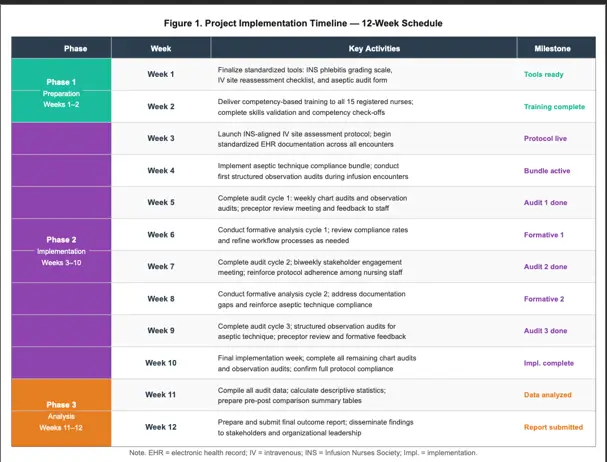
A project timeline is used to establish structure and expectations for implementation productivity to ensure all project activities are completed within a set amount of time. The project time frame is 12 weeks and there are three (3) phases – preparation phase (2 weeks), implementation phase (8 weeks), and data analysis and dissemination phase (2 weeks). Having a quality improvement project organized in steps and sequential phases within a PDSA framework, as in PDSA, improves productivity, increases stakeholder engagement and facilitates more measurable outcomes to be achieved in the set time horizon (as evidenced by, Pathan et al., 2024).
The formation of weekly milestones for each of the following project steps creates a clear and concise week-by-week timeline: Tool finalization, staff training, protocol, chart audit, observation Audit, Formative Analysis and Final Outcome Reporting (all of which are to be carried out once/week for 12 weeks). Timelines will be developed to ensure that elements of the project are carried out sequentially and any potential issues with the integrity of project implementation are identified as early as possible.
Figure 1
Project Implementation Timeline
Practicum Hours Plan of Action
In order to demonstrate advanced clinical scholarship and professional competence as part of the DNP program, students must accumulate 1,000 practicum hours working on the course assignments from 4 different courses (NURS-FPX9000, NURS-FPX9020, NURS-FPX9030, & NURS-FPX9040). The 1,000 hours will be spread over time within the core courses, and the projects will be individualized to the course content and the Infusion Safety Quality Improvement Initiative. Lewis et al. (2022) confirmed that having a competency-based structure in practicum experience enhances your clinical leadership ability and provides an evidence-based practice and quality improvement project management approach to advanced nursing roles.
Some of the activities that will take place throughout the DNP program are: a literature review, site assessment, stakeholder involvement, protocol development, staff education/training, data collection, audit monitoring, formative assessment, and final outcome dissemination. The practicum hour plan specifies the way that all projects will be credited toward the total 1000 hours required of the DNP program, and also breaks down the different amounts each individual class work (project) will contribute to that total.
Table 1
DNP 1,000-Hour Practicum Plan of Action
DNP 1,000 Practicum Hour Plan Of Action | |||
Transfer Hours – Please indicate if they have been approved or submitted. | |||
DNP Project Hours | Total from core courses. | 1000 | |
Hours from NURS 9000. | 100 | ||
Projected hours from NURS9010. | 100 | ||
Practicum Hours Include a description of the activity and estimated hours. Add additional rows as needed. | Course | Activity | Planned hours |
NURS9000 | Literature review and topic identification for infusion safety project | 30 | |
Practice site identification, preceptor meetings, baseline data review | 30 | ||
CITI training completion and topic report writing | 40 | ||
NURS9020 | Project proposal development and submission for mentor review | 50 | |
Stakeholder engagement meetings and needs assessment at the project site | 50 | ||
Development of INS-aligned IV site assessment protocol and tools | 50 | ||
Development of an aseptic technique compliance bundle and audit checklist | 50 | ||
Preceptor collaboration meetings and project planning documentation | 50 | ||
IRB/ethics review preparation and HIPAA compliance planning | 50 | ||
NURS9030 | Delivery of competency-based training to all 15 registered nurses | 60 | |
Implementation of INS-aligned IV site assessment protocol at practice site | 80 | ||
Implementation of the aseptic technique compliance bundle across all encounters | 80 | ||
Weekly EHR chart audits and phlebitis grading, and compliance monitoring | 60 | ||
Structured observation audits for aseptic technique during infusion encounters | 60 | ||
Formative analyses and biweekly preceptor review meetings | 30 | ||
Total Practicum Hours | 1000 | ||
Conclusion
The quality improvement project will involve a standardized, INS-aligned IV site assessment and documentation protocol, as well as an aseptic competence compliance bundle that includes competency-based training, all of which will aim to reduce complications from infusion therapy in adult populations receiving outpatient infusion therapy. The interventions will take place during a 12-week period in a privately owned outpatient infusion center. Data points will be collected via chart audits each week and structured observation audits, analyzed, and shared with stakeholders using descriptive statistics throughout the implementation process.
To sum up, the purposes of the implementation of the proposal are to: Improve patient safety, Improve the competency of the nursing staff, Improve the accuracy of documentation, and Replicate a model of evidence-based standardizing infusion care by using a PDSA conceptual frame and empirical literature for clinical significance and measurable practice gaps identified through baseline chart audits of 15 registered nurses with a complication rate of fourteen percent.
Related Assessment: NURS FPX 9010 Assessment 3
References
Calderwood, M. S., Anderson, D. J., Bratzler, D. W., Dellinger, E. P., Garcia, H. S., Maragakis, L. L., Nyquist, A. C., Perkins, K. M., Preas, M. A., Saiman, L., Schaffzin, J. K., Schweizer, M., Yokoe, D. S., & Kaye, K. S. (2023). Infection Control & Hospital Epidemiology, 44(5), 695–720. https://doi.org/10.1017/ice.2023.67
Costa, P. S., Paiva-Santos, F., Sousa, L. B., Bernardes, R. A., Ventura, F., Fearnley, W. D., Oliveira, A., Parreira, P., Vieira, M., & Graveto, J. (2022). Nurses’ practices in the peripheral intravenous catheterization of adult oncology patients: A mix-method study. Journal of Personalized Medicine, 12(2), e151. https://doi.org/10.3390/jpm12020151
Elhihi, E., Lafi, K., Alahmadi, M., Al-theiba, M., Abdul Rahman, A., Maghrabi, N., Mizi, S., Alsulami, H., Altambkti, M., & Rumbo, T. (2025). Worldviews on Evidence-Based Nursing. https://doi.org/10.1111/wvn.70096
Infusion Nurses Society. (2025). Infusion therapy standards of practice. https://www.ins1.org/publications/infusion-therapy-standards-of-practice/
Jacobs, L. (2022). Peripheral intravenous catheter insertion competence and confidence in medical/surgical nurses. Journal of Infusion Nursing, 45(6), 306–319. https://doi.org/10.1097/nan.0000000000000487
Lewis, L. S., Rebeschi, L. M., & Hunt, E. (2022). Nursing education practice update 2022: Competency-based education in nursing. SAGE Open Nursing, 8(1). https://doi.org/10.1177/23779608221140774
Marsh, N., Larsen, E., Ullman, A., Cooke, M., Chopra, V., Ray-Barruel, G., & Rickard, C. M. (2024). Peripheral intravenous catheter infection and failure: A systematic review and meta-analysis. International Journal of Nursing Studies, 151(1), e104673. https://doi.org/10.1016/j.ijnurstu.2023.104673
Nickel, B., Gorski, L., Kleidon, T., Kyes, A., DeVries, M., Keogh, S., Meyer, B., Sarver, M. J., Crickman, R., Ong, J., Clare, S., & Hagle, M. E. (2024). Infusion therapy standards of practice, 9th edition. Journal of Infusion Nursing, 47(1), 1–285. https://doi.org/10.1097/nan.0000000000000532
Staples, J. A., Ho, M., Ferris, D., Hayek, J., Liu, G., Tran, K. C., & Sutherland, J. M. (2022). Outpatient versus inpatient intravenous antimicrobial therapy: A population-based observational cohort study of adverse events and costs. Clinical Infectious Diseases, 75(11), 1921–1929. https://doi.org/10.1093/cid/ciac298
Tegegne, B., Checkole, D., Shumye, M., Zeru, M., Yalew, Z., Ademe, S., Shiferaw, M., & Edmealem, A. (2025). Knowledge, practice, and factors affecting peripheral intravenous catheters among nurses working in Dessie City public hospitals. BMC Nursing, 24(1). https://doi.org/10.1186/s12912-025-03484-0